

- Commonwealth Bank of Australia (“CBA”) is the nation’s leading provider of integrated financial services and one of its largest banks.
- CBA recorded strong profit growth in 1H23, with improved operating performance. Net interest income saw robust growth due to volume recovery and higher net interest margin.
- Credit profile remains strong as CBA stays well-provisioned with improved credit quality, and possesses strong liquidity and capital positions.
- We recommend CBAAU 6.860% 09Nov2032 Corp (AUD). For investors who prefer USD-denominated bonds, we recommend CBAAU 4.500% 09Dec2025 Corp (USD). For investors seeking a safer option, we recommend the senior unsecured CBAAU 4.200% 11Jun2026 Corp (AUD).
About Commonwealth Bank of Australia
Commonwealth Bank of Australia (“CBA”) is a multinational bank with operations across Australia, New Zealand, Asia, US, and the United Kingdom. The bank operates mainly across three divisions:
- Retail banking services (“RBS”) provides banking and general insurance products and services to personal and private bank customers. CBA’s RBS has an extensive network of more than 750 branches and 2,000 ATMs.
- Business banking (“BB”) provides financial services solutions to business, corporate, and agribusiness customers. This also includes equities trading and margin lending services.
- Institutional Banking & Markets (“IB&M”) provides a full range of domestic and global financing and banking services to corporate, institutional and government clients. This also includes services from debt capital markets, risk management to research and data analytics.
- New Zealand business, otherwise known by its subsidiary, ASB Bank (“ASB”) provides banking, wealth and insurance products and services to personal, business, rural and corporate customers in New Zealand.
CBA was founded under the Commonwealth Bank Act in 1911 and commenced operations in 1912. Today, it is Australia’s leading provider of integrated financial services and one of the nation’s largest banks, holding around 22% of the banking system’s assets as of end-2022. The bank also holds around a fifth of New Zealand's banking system assets. Based on reported market share estimates from the Australian Prudential Regulation Authority (“APRA”), CBA holds a strong market share in Australia across home loans (25.8% of the banking system), credit card loans (28.8%), household deposits (26.9%), Business loans (17.8), business deposits (22.4%).
All three major credit rating agencies have stable outlooks on the group, with ratings of ‘A+‘ by Fitch, ‘Aa3’ by Moody’s and ‘AA-‘ by Standard & Poor’s.
Financial Highlights
CBA recorded an increase in net profit after tax (“NPAT”) in the half year ended 31 December 2022 (1H23). Statutory NPAT grew 6% from AUD $4,932M (2H22) to AUD $5,216M (1H23) while cash NPAT also grew 6% from AUD $4,849M to AUD $5,153M (Chart 1). In particular, the increase in cash NPAT reflected stronger operating performance for the bank. Total operating income for the bank was up 8% from AUD $12,066M (2H22) to AUD $13,593M (1H23). This was meaningfully driven by a 20% increase in net interest income (“NII”) from AUD $9,725M (2H22) to AUD $11,637M (2H22), despite a decline in other operating income due to divestments of assets.
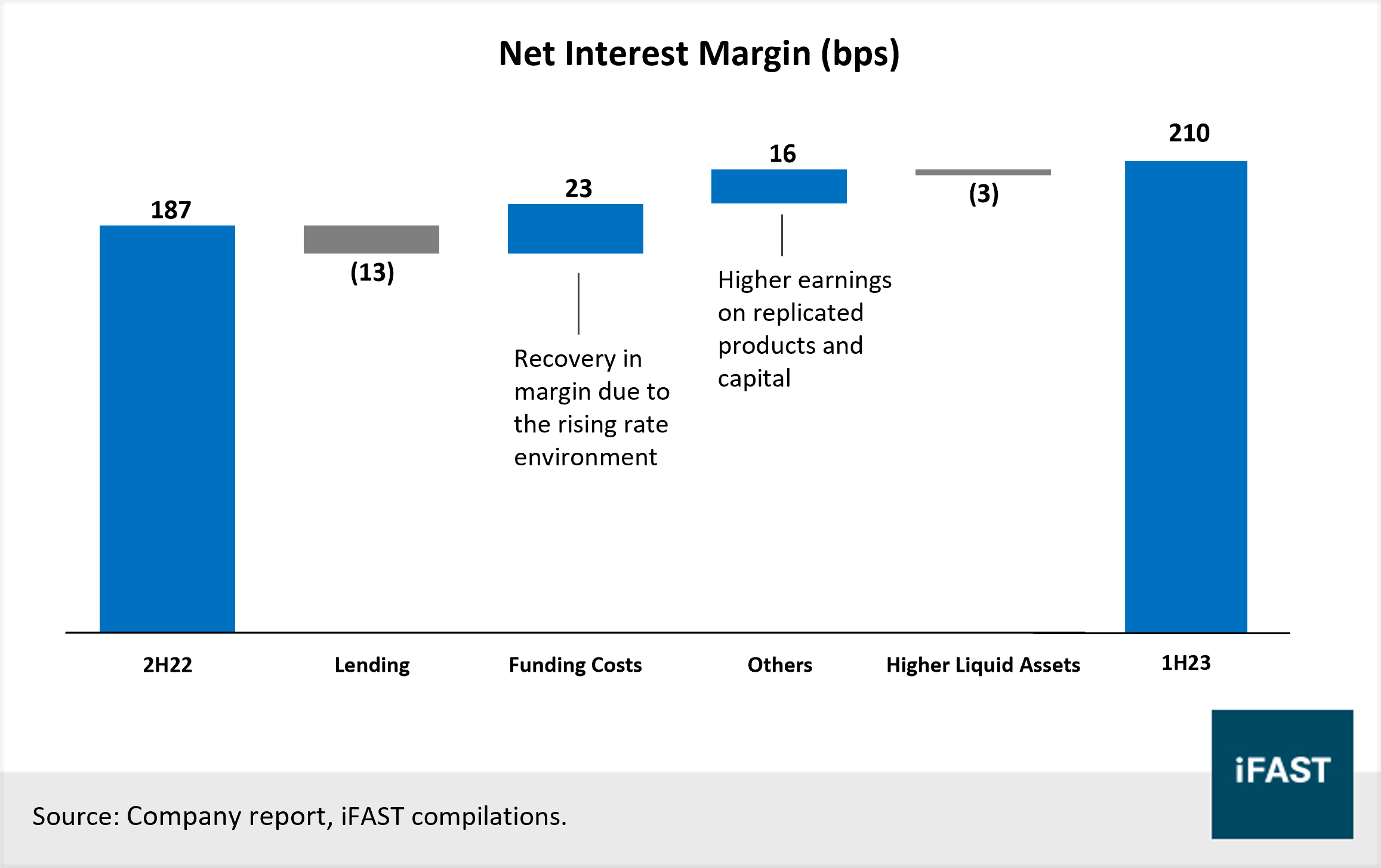
The bank’s stronger NII was a result of two factors. First, a healthy recovery across loans from all categories. Loan volume grew across all segments - Consumer financing, home, business, and institution loans – with the latter two showing strong growth. Second, net interest margin (“NIM”) improved from 2H22, growing 23bps from 1.87% to 2.10% (1H23) as rising interest rates enabled margins to recover while earnings on deposits, replicated products, and equity hedges improved (Chart 2). In particular, NIM has recovered to the highest level over the past three years.
Chart 1: Strong operating income in 1H23 has helped drive robust NPAT growth
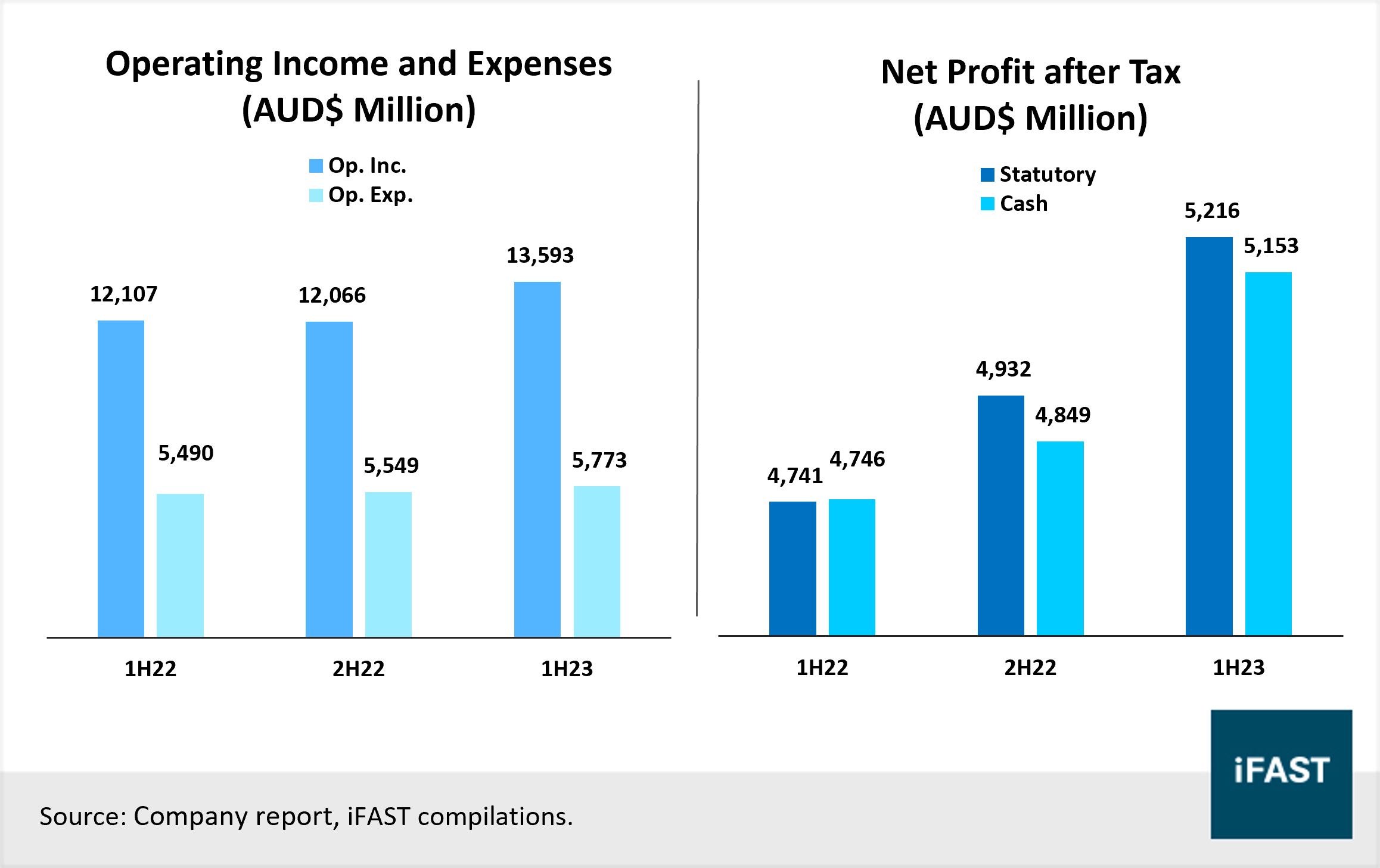
Chart 2: Net interest margins improved from 2H22 due to the higher interest rate backdrop
Cost for the bank remains well-contained with total expenses maintained around AUD $5,773 million, at levels seen across the previous year. However, the bank did recognise higher impairment expenses of AUD $511M, an increase of AUD $793M from 2H22. By the bank’s standard, this is considered a large expense and was the result of a challenging macro backdrop, supply chain issues, and falling housing prices. Despite these costs and impairment expenses, strong operating income was able to offset and contribute to the NPAT.
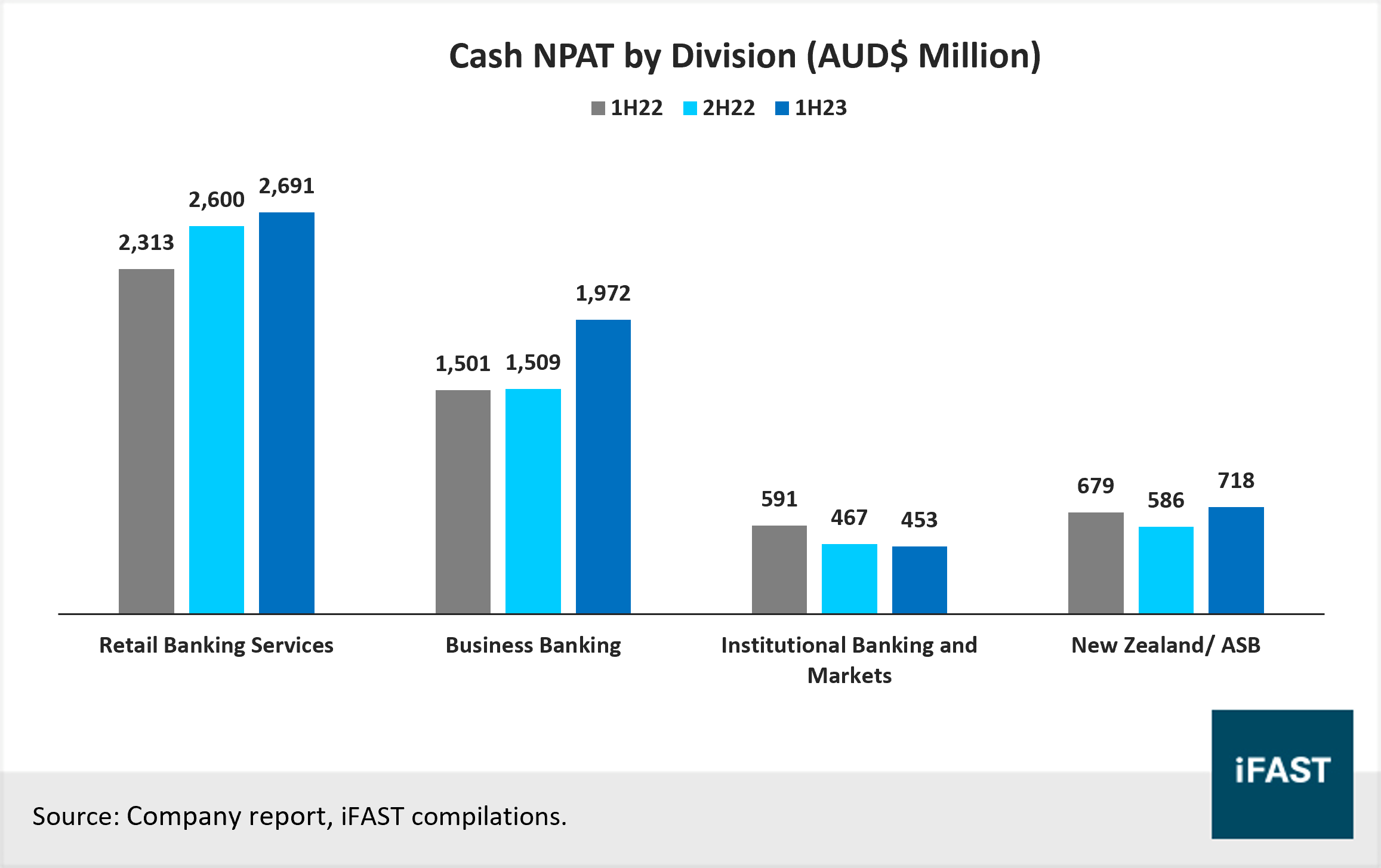
By division, the bank’s RBS and BB segments are the most profitable (chart 3). The RBS segment saw a 21% increase in net interest income from AUD $4,757M (2H22) to AUD $5,775M (1H23). This drove a 3.5% increase in cash NPAT from AUD $2,600M (2H22) to AUD $2,691M (1H23). The BB segment saw a 29% increase in net interest income from AUD $2,973M (2H22) to AUD $3,832M (1H23). This drove a large 31% increase in cash NPAT from AUD $1,509M (2H22) to AUD $1,972M (1H23). Higher deposit margins and earnings on equity played a large part in supporting profits of both segments despite lower home lending and consumer finance margin.
Chart 3: CBA’s retail and business banking services are the most profitable segments
Business Outlook
We expect NII to see strong growth in FY23 as the cumulative impact of Reserve Bank of Australia’s (“RBA”) five rate hikes (since the start of 2023) kicks in despite a likely plateauing of loan growth due to the cyclical slowdown in lending. Potential rate hikes might further bolster NII as the bank expects margins to improve by 4bps with each 25bps hike. Beyond FY23 (2H23 onwards in terms of calendar year), we expect slower growth in NII as RBA reaches peak rates and intense home loan and deposit price competition offsets the benefit of high rates. We expect other operating income to see slow growth in FY23 and beyond given sticky but stable commissions, fees, and trading income.
Operating expenses are likely to increase in FY23 and beyond but at a slower pace as inflationary pressure on wage and supplier inflation eases. The two largest divisions RBS and BB have also demonstrated consistent falling cost-to-income, which suggests cost should be manageable relative to NII. In sum, we expect strong pre-provision income growth in FY23 but softer growth over the next few years given robust NII growth this year, stable growth in other operating income, and milder increases in operating expenses.
That said, given CBA’s prudent stance, we expect impairment costs to increase in FY23 and over the next couple of years. In our view, loan provisions should return closer to long-run averages and subsequently rises as financial conditions worsen. As such, accounting for loan provision, CBA’s NPAT may peak in FY23 and moderate until the economic condition improves. Consensus expects earnings to rebound as early as FY25.
Credit highlights
1. Asset Quality
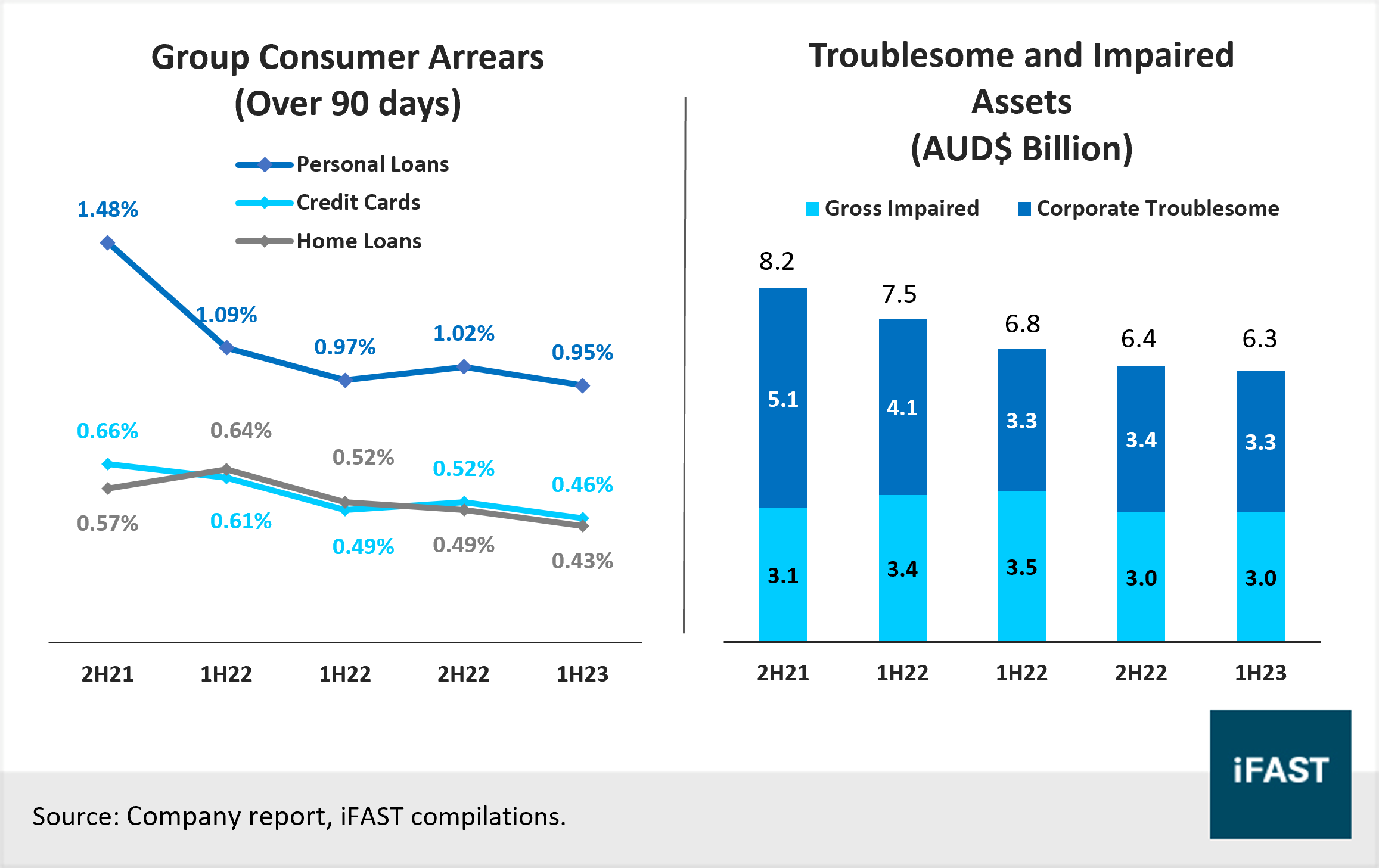
CBA’s credit quality continued to improve in 1H23 across both corporate and consumer lending. For business and corporate lending, the bank maintains its elevated exposure to high-quality loans. 71.0% (1H23) of commercial loan exposures are investment grade quality, of which 62.6% are of the highest “AAA” to “A-“ rating. We believe the strong exposure to high-quality loans contribute to a relatively low amount of corporate troublesome assets, which fell by AUD $0.1B from AUD $3.4B (2H22) to AUD $3.3B (1H23) (chart 4).
For consumer lending, we see little risk for the bank’s loan book. Arrears over 90 days (loans due over 90 days) continue to fall in 1H23 (chart 4). All segments – Credit cards, home and personal loans - saw a decline in arrears due to seasonal impacts like tax refunds and a strong labor market. Despite the intense competition in Australia’s mortgage market and high refinancing costs, home loan arrears for the bank are also at near-record lows at 0.43%. However, arrears should pick up gradually as Australia’s economy slows while the RBA keeps rates high.
Overall, troublesome and impaired assets (TIA) fell by AUD $0.1B from AUD $6.4B (2H22) to AUD $6.3B (1H23), led by an equivalent fall in corporate troublesome assets while gross impaired assets remain unchanged at AUD $3.0B. Gross impaired assets as a percentage of gross loans and acceptances remained low at 0.33% (1H23), similar to the previous half, which is another reassuring sign.
In terms of provision, CBA remains well-provisioned amidst a challenging macro backdrop. The bank has increased provisions by AUD $194M from AUD $5,347M (2H22) to AUD $5,541M in 1H23. This is approximately AUD $2B above management’s central economic scenario, an additional buffer in case the economic condition worsens. We think total provisions remain significant, which is around 60% of gross loans and acceptances, and more than sufficient to cover impaired assets with a ratio (total provisions as a percentage of impaired assets increased) of 182.5%.
Chart 4: Consumer arrears as well as troublesome and impaired assets continue to fall
2. Capital Position and Liquidity
CBA was able to maintain a strong capital position after the payment of dividends and buy-backs. Capital adequacy ratio improved to 17.8% (end 1H23) from 17.6% (end 2H22), driven primarily by tier 2 capital (as a percentage of risk-weighted assets) which increased 50bps to 4.5% (end 1H23) while tier 1 capital fell marginally by 30bps to 13.3% (end 1H23). While this suggested a slight deterioration in the quality of capital, we do not find it concerning mainly as CET1 ratio remains steady.
CET1 ratio maintained at 11.4% (end 1H23), a marginal decline of 10 bps from 11.5% (end 2H22). Under APRA’s (Australian Prudential Regulation Authority) revised capital framework which was implemented on 1 January 2023, the pro-forma CET1 ratio was 12.1%. Both CET1 ratio measures were much higher than the regulatory prudential minimum of 8.00% and 10.25% respectively. Given the bank’s robust capital position, management has decided to increase share buy-back by an additional AUD $1 billion. This is expected to lower CET1 ratio by 25 bps but it should remain far above the regulatory minimum.
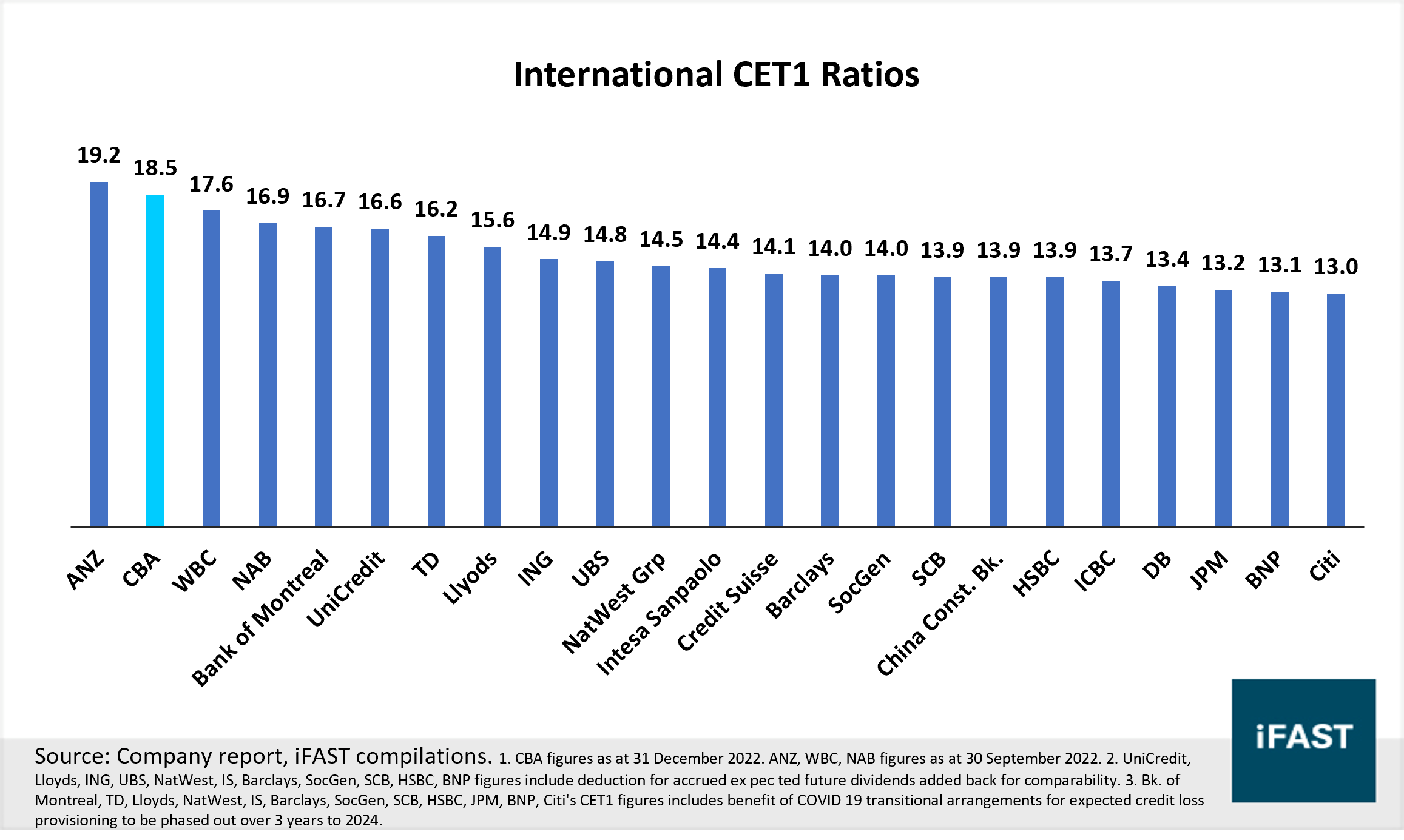
Compared to global banks, CBA’s capital position remains strong. On an internationalised basis (assuming Basel III capital reforms are fully implemented), CBA Bank’s CET1 ratio was 18.5% (as at end-2022), which was one of the highest amongst peers (chart 5). CBA’s net Stable Funding Ratio (“NSFR”) was 129% at 31 December 2022, which remains well above the regulatory minimum of 100%.
Chart 5: CET1 ratio for CBA remains high compared to global peers
CBA has also maintained a strong liquidity position. It continues to satisfy a significant portion of its funding requirements from customer deposits as the deposit funding ratio improved to 75% (1H23), from 74% (2H22). The large amount of customer deposits contributes to a more stable funding profile. The bank has also improved the amount of high quality liquid assets (“HQLA”), which rose by AUD $11,327M over the quarter to AUD $185,465M (ended 31 Dec ‘22). As such, liquidity coverage ratio (LCR) was able to maintain at a strong 131% (ended 31 Dec ‘22), above the regulatory minimum of 100%.
Recommendations
Table 1: Comparable bonds
|
Issue |
Ask Price |
Yield to Maturity/ Yield to Call (%) |
Years to Maturity/ Years to Call |
Bond Credit Rating (S&P/Fitch) |
|
102.71 |
6.55 / 6.13 |
9.33 / 4.33 |
BBB+/ A- |
|
|
100.66 |
6.65 / 6.61 |
14.68 / 9.68 |
BBB+/ A- |
|
|
97.47 |
5.64 |
2.41 |
BBB+/A- |
|
|
95.40 |
6.88 |
7.70 |
BBB+/A |
|
| 91.13 | 6.26 / 6.30 | 8.35 / 3.35 | BBB+/A- | |
|
100.98 |
6.47 / 6.21 |
11.20 / 6.19 |
BBB+/A- |
|
|
Sources: Bloomberg Finance L.P., Bondsupermart, iFAST Compilations. Data as of 13 July 2023. |
||||
Overall, the credit profile for CBA remains strong as the bank stays well-provisioned with better credit quality, and possesses strong liquidity and capital positions. Looking ahead, we think the challenging macro backdrop will likely weigh on credit quality of Australian banks, but with strong pre-provision income, CBA is likely to maintain well-provisioned with better capital and liquidity position relative to banking peers.
Among the AUD Tier 2 subordinated bonds (Table 1), CBA offers CBAAU 6.860% 09Nov2032 Corp (AUD) and CBAAU 6.704% 15Mar2038 Corp (AUD). We prefer CBAAU 6.860% 09Nov2032 Corp (AUD) given (1) our preference for shorter years to maturity/ call, while (2) the yield pickup on the longer-dated bond is only attractive for a call situation (16bps pickup for non-call; 58bps pickup for call; 5.35 remaining years).
While CBA’s 2032 bond offer a slightly lower yield as compared to BACR 6.100% 24Mar2031 Corp (AUD), CBA has a stronger credit profile in our view. For investors who prefer USD-denominated bonds, we recommend the Tier 2 subordinated CBAAU 4.500% 09Dec2025 Corp (USD). The bond is currently yielding ~5.6% with 2.41 years left to maturity.
Under the Basel III framework for Tier 2 capital, Tier 2 securities that remain uncalled past the first reset date will have to be amortized in the balance sheet of the company. This also means that there is an incentive for the banks to call back on their Tier 2 subordinated bonds and to re-issue new Tier 2 bonds to ensure capital remains sufficient on their balance sheet. We would like to remind investors that Tier 2 subordinated bonds are ultimately subjected to loss absorption upon a trigger, although the CET1 and AT1 instruments would be utilised first prior to the activation of Tier 2 securities for loss absorption.
For investors looking for safer options without the risk of loss absorption, we recommend the senior unsecured CBAAU 4.200% 11Jun2026 Corp (AUD) with a credit rating of AA- by S&P Ratings. Notably, the bond is currently yielding ~5.0% with 2.91 years left to maturity.
Declaration: For specific disclosure, at the time of publication of this report, IFPL (via its connected and associated entities) and the analyst who produced this report holds nil position in CBAAU 6.860% 09Nov2032 Corp (AUD), CBAAU 4.200% 11Jun2026 Corp (AUD), CBAAU 4.500% 09Dec2025 Corp (USD).
Our podcast series, Yield Hunters, is available on Spotify, iTunes Podcasts and Google Podcasts. We share our thoughts on new bond issues and hold discussions on the fixed income space. Listen to our latest episode below and follow us!